
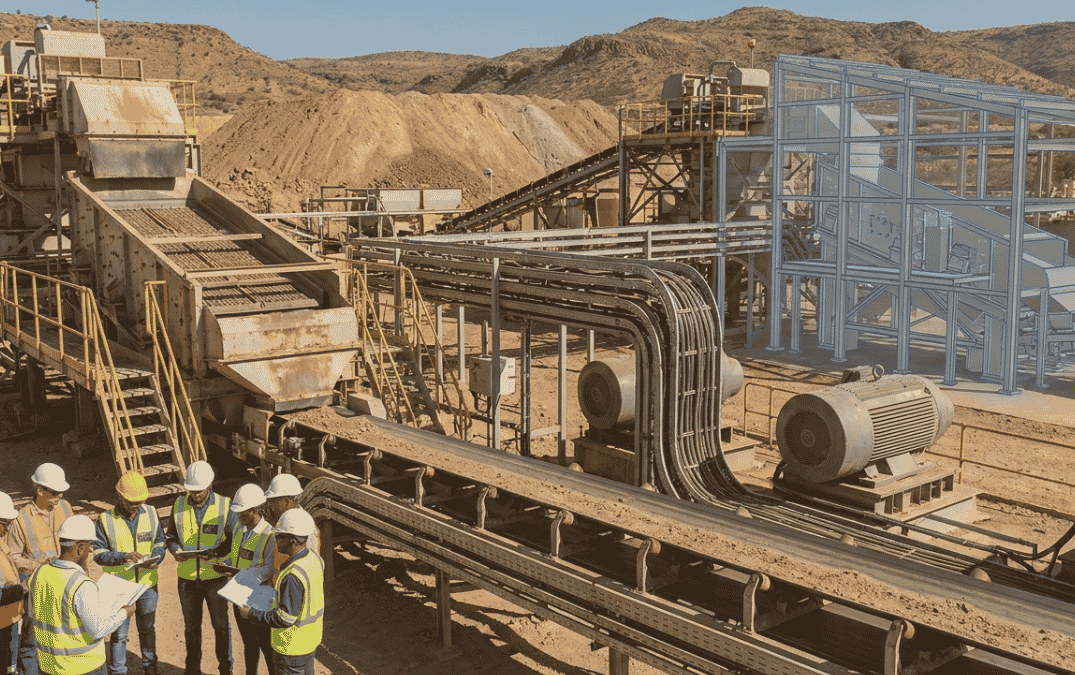
Engineering Design Checks Before Mining Plant Expansion
By Ninya Claassen
Expanding an existing mining process plant is rarely as simple as installing a larger crusher, adding another screen or increasing conveyor capacity. Every new piece of equipment places additional demands on the plant around it: foundations may need to carry higher loads, electrical demand increases, control systems need extra inputs and outputs, and existing pipework or cable routes can clash with the new layout. Solving one bottleneck can simply expose another further downstream.
Quick answer
A successful brownfield mining plant expansion therefore starts with engineering verification, not fabrication. CSS Engineering approaches expansions as an integrated engineering problem — understanding what already exists, defining what the expansion will change, and confirming the surrounding plant can actually support the additional capacity.
1. Verify As-Built Site Conditions
The first check on any brownfield project is whether the drawings being used still reflect the plant standing on site today. Structures get modified, pipes rerouted, platforms extended and chutes altered during shutdowns throughout a plant’s operating life — so original drawings often no longer match reality, and relying on them risks a clash the moment new equipment is installed.
- Actual equipment and structural steel positions
- Floor, platform and column elevations
- Pipe routes and cable tray layouts
- Existing chutes, transfer points and conveyor interfaces
- Equipment foundations and maintenance clearances
Where the plant has changed significantly, 3D laser scanning and point-cloud modelling builds a far more reliable as-built picture than re-measuring by hand, and flags clashes before fabrication rather than during installation — this is why accurate plant design data matters before fabrication.
2. Confirm Foundation, Geotechnical and Structural Capacity
Expansions frequently introduce equipment with different static and dynamic loads than what the original foundations were designed for. Larger crushers, additional screens, mills and new drives can all shift load paths in ways that aren’t obvious until modelled.
- Can the existing foundations carry the additional load? Adding equipment to an existing structure can change load paths significantly.
- Will the equipment introduce vibration? Crushers, screens and mills can create cyclic or dynamic forces that need more than a static calculation.
- Are independent foundations required? Larger equipment sometimes needs its own footing rather than a strengthened existing one.
- Have ground conditions changed? Nearby excavations or historical construction can affect what’s assumed safe today.
Beyond the foundations, platforms, beams, columns and conveyor structures need their own load review — dead, operating, dynamic, maintenance, lifting and access-platform loads, plus new piping and cable-support weight. Specialist geotechnical input is often still required to confirm soil conditions and bearing capacity; this should sit inside the expansion’s design basis from the start, not be treated as a separate construction-phase issue.
3. Recalculate Electrical Load and Drive Capacity
Physical space for another crusher, pump or mill doesn’t mean there’s spare electrical capacity to run it. Increasing throughput increases connected and operating load, and this needs to be checked before layout is finalised, not discovered once the plant is already designed.
- Motor power requirements and starting currents
- Existing load lists against transformer and MCC capacity
- Distribution boards, cable sizing and protection settings
- Variable-speed drive and emergency power requirements
- Spare capacity for further future expansion
Upgrading a conveyor, for example, is rarely just a motor swap — the new duty can affect the motor, gearbox, drive and power supply together. CSS Engineering’s electrical motor and AC/DC rewinding capability, alongside its drive systems work, gives a practical link between the mechanical duty of new equipment and the infrastructure that has to drive it. A transformer or MCC shortfall found late in a project can affect the whole expansion programme, so electrical scope is best developed alongside the mechanical design, not after it.
4. Review PLC, Instrumentation and Control Capacity
New equipment adds motors, sensors, level switches, flowmeters, interlocks and safety devices that the existing control system has to monitor and manage. The PLC and instrumentation architecture should be reviewed before implementation, not after.
- Does the PLC have spare I/O capacity? New equipment usually needs additional digital and analogue inputs and outputs.
- Does the control philosophy need to change? An extra process stage can alter start-up sequences and upstream/downstream interlocks.
- Are emergency-stop systems affected? New equipment must be properly built into the plant’s existing safety philosophy.
- Can operators still control the expanded process? HMI screens and alarms may need updating so the larger circuit stays understandable.
Control and instrumentation upgrades often sit alongside a specialist controls integrator’s scope. CSS Engineering’s role here is making sure the mechanical and drive-system design it delivers feeds cleanly into that controls scope, rather than the two being designed in isolation.
5. Confirm Water and Utility Capacity
Water is an easy constraint to miss during a beneficiation plant expansion. Washing, classification, flotation and dewatering can all demand more process water than the existing system was sized for, which is why the mass balance and water balance need to stay connected to the design — pump capacity, pipe sizing, recycle-water systems and tailings-water recovery all included. CSS Engineering’s process-design approach already treats water and energy constraints as part of the design basis for beneficiation plants, rather than an afterthought once the flowsheet is fixed.
The same logic applies to other utilities: compressed and instrument air, cooling water, lubrication, ventilation and dust extraction, drainage and fire-water infrastructure should all be checked against the new operating duty. An expansion is only successful if the supporting services can actually sustain it.
6. Recheck Process Bottlenecks at the New Throughput
Increasing one machine’s capacity doesn’t automatically increase the plant’s capacity — it can simply move the restriction. A larger crusher can overload the screen; a larger screen can overload the conveyor; more milling capacity can expose limits in classification or dewatering. The expansion needs modelling as a complete process circuit:
- Crushing, screening and milling capacity
- Conveyor and chute loading
- Pump duty and piping capacity
- Classification, separation and dewatering performance
This is the core of debottlenecking, and it’s how plant design reduces bottlenecks in mineral processing. CSS Engineering’s brownfield expansion and optimisation work is built around exactly this — the goal isn’t to install more equipment, it’s sustainable plant throughput.
7. Check Piping and Mechanical Interfaces
Existing process piping can easily conflict with a proposed expansion. Before new equipment goes in, engineers should confirm pipe sizes suit the new flow rates, pumps operate within suitable duty ranges, existing pipe supports can carry any new loads, isolation points stay accessible, and proposed piping won’t clash with structures or cable trays — and that it can actually be installed within the available shutdown window. CSS Engineering’s process piping, fabrication and installation capability is another reason to resolve these interfaces at the engineering stage rather than correcting them on site.
8. Plan Maintenance Access, Shutdown Tie-Ins and Commissioning
Three things separate a smooth brownfield expansion from a costly one, and all three need designing in from the start:
- Maintenance access: bearing, motor, gearbox and liner replacement routes, lifting equipment and laydown areas — a plant that hits higher throughput but needs excessively long shutdowns for routine servicing hasn’t really been optimised. See what makes a beneficiation plant easier to maintain.
- Shutdown interfaces: tie-in points, isolation requirements, temporary bypasses and installation sequencing — because unlike a greenfield build, the existing plant often needs to keep producing during the project.
- Commissioning: how systems will be inspected, energised, tested and ramped up should shape the design itself, not just close out the project programme. CSS Engineering’s installation and commissioning approach builds this sequence in from the start.
Carrying accurate design information through to shutdown planning is one of the most direct ways to reduce downtime during a mining plant upgrade.
Mining Plant Expansion Requires Integrated Engineering
A mining plant expansion is ultimately an interface-management exercise. Changing throughput ripples through process, equipment, structure, electrical load, controls, utilities and maintenance in sequence — which is why the engineering design stage matters more than the fabrication stage.
CSS Engineering provides mining process plant design and brownfield expansion support that connects engineering design with fabrication, drive systems, process piping, installation and commissioning under one point of accountability. Verifying existing conditions and resolving interfaces before fabrication begins reduces redesign, avoids site clashes, and takes the uncertainty out of an expansion shutdown.
Related reading: Top Mining Plant Design Questions
Frequently Asked Questions
What should be checked before expanding a mining plant?
Existing site conditions, foundation and structural capacity, electrical capacity, PLC and instrumentation spare capacity, water and compressed-air availability, process bottlenecks, piping interfaces, and maintenance and shutdown access should all be verified before detailed expansion design begins.
Why must electrical capacity be checked before a mining plant expansion?
Additional crushers, conveyors, pumps and mills increase electrical demand. Existing transformers, MCCs, cables and protection systems need assessing to confirm they can carry the increased load before the mechanical design is finalised.
Why are geotechnical checks important for plant expansion?
New or heavier equipment can introduce different static and dynamic foundation loads. Ground conditions and existing foundation capacity should be verified, since specialist geotechnical input is often needed before construction.
Does increasing crusher capacity increase total plant production?
Not necessarily. Higher crusher throughput can expose downstream restrictions in screens, conveyors, mills, pumps or dewatering systems, so the complete process circuit needs evaluating for bottlenecks — not just the one machine being upgraded.
How can engineering reduce downtime during a brownfield plant expansion?
Accurate as-built data, 3D scanning, early interface checking, detailed engineering and pre-fabrication all let more problems get resolved before work reaches site, which reduces uncertainty and shortens the shutdown itself.
