
Quick Answer:
Strategic mineral processing plant design reduces bottlenecks by optimizing material flow, selecting robust crushers and mills, and building flexibility into the processing circuit. Rather than just installing larger individual machines, engineers prevent choke points by sizing conveyors and surge bins to peak tonnage, managing ore variability through flexible comminution circuits, and utilizing 3D scanning to ensure precise structural alignment during brownfield upgrades.
A mineral processing plant is only as capable as its most restricted stage. Installing a 500-tonne-per-hour (t/h) crusher does not guarantee a 500 t/h plant if the downstream classification circuit can only process 420 t/h. When maximum equipment capacity does not equal maximum plant capacity, a bottleneck forms.
For this reason, CSS Engineering approaches mining process plant design from a systems-level perspective. By correctly balancing capacities across crushing, screening, milling, separation, and materials handling, we eliminate hidden choke points before construction begins.
Flow and Layout Optimization
Capacity limits often hide in plain sight—not within the major process machines, but in the spaces between them. Effective debottlenecking starts with the fundamental layout and the engineering mass balance.
Smooth Material Movement
A highly optimized layout moves ore directly from crushing to grinding and flotation without sharp turns, unnecessary elevation changes, or dead zones. By developing beneficiation plant design data accurately from day one, engineers map out where circulating loads occur and how a change in one process affects downstream recovery. Eliminating redundant transfer points directly reduces wear, spillage, and blockages.
Avoiding Choke Points in Materials Handling
Conveyors, transfer chutes, and storage bins must be sized to match the maximum expected peak tonnage, not just the plant’s average flow. A transfer chute that progressively accumulates wet fines will reduce its effective opening over time, eventually choking the entire upstream circuit. Materials handling must be engineered as a core part of the process, ensuring hoppers and bins provide sufficient buffer capacity so that a minor downstream stoppage doesn’t immediately shut down the primary crusher.
Managing Ore Variability
One of the starkest differences between a theoretical flowsheet and an operating mine is ore variability. Actual feed fluctuates in hardness, grade, moisture, and particle size distribution. Designing a plant for a single, fixed operating condition guarantees future bottlenecks.
Targeting Primary Mills and Comminution
Run-of-mine (ROM) and SAG mills frequently form the main limit on circuit capacity. Harder ore profiles can drastically reduce grinding throughput and increase circulating loads. Proper plant design balances grinding media, power draw, and classification efficiency to absorb these shifts. Integrating smart process control systems further protects throughput by adjusting feed rates automatically before a mill overload occurs.
Robust, Flexible Equipment
To absorb shifts in mineralogy, engineers build flexibility directly into the circuit. Designing flexible, multi-stage crushing circuits provides the necessary turndown ratios to handle varying rock hardness without stalling operations. The goal is to establish a wide, robust operating envelope where the plant maintains target recovery regardless of reasonable feed fluctuations.
Upgrades, Maintenance, and Digital Planning
When an existing mineral processing plant experiences capacity restrictions, simply installing a larger machine is rarely the answer. Expanding a brownfield facility requires precision to avoid creating new physical bottlenecks like structural clashes, blocked maintenance walkways, or restricted crane access.
Digital Planning and 3D Scanning
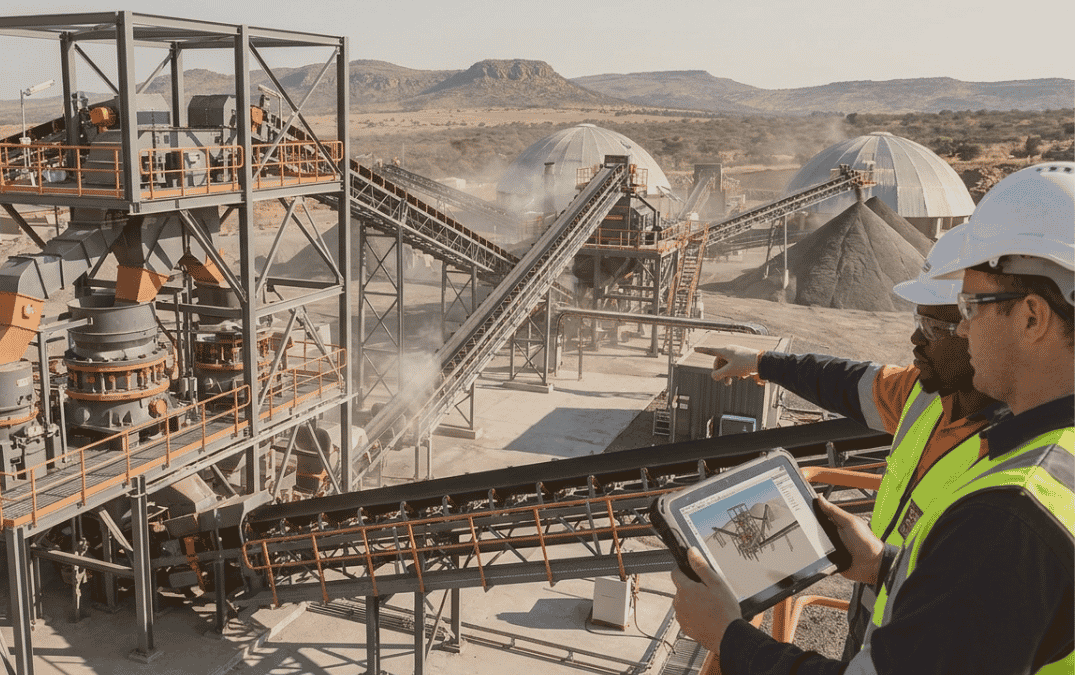
Understanding how 3D scanning improves mining plant design accuracy is critical for modern plant optimization. By capturing a highly detailed digital twin of the existing facility, CSS Engineering prevents structural misalignments during expansions. Digital clash-detection allows us to solve spatial restrictions in a 3D model rather than discovering them during a costly construction shutdown.
Reducing Downtime Through Maintainability
Maintenance access is a direct throughput issue. If replacing a screen panel takes 12 hours due to poor access instead of 4 hours, that is 8 hours of lost production capacity. By prioritizing component removal routes and safe isolation points, CSS Engineering plays a major role in reducing downtime during mining plant upgrades.
How CSS Engineering Delivers Plant Optimization
Debottlenecking is about finding the true restriction. If the true constraint lies in downstream flotation, adding upstream crushing capacity will only produce more waiting material.
Through our comprehensive plant optimisation audit services, CSS Engineering follows a rigorous methodology: Measure → Identify → Model → Engineer → Modify. We combine process data analysis, 3D laser scanning, structural engineering, and precision fabrication to physically correct flow restrictions. Whether you are developing a new turnkey beneficiation plant or expanding an aging facility, we provide the integrated engineering required to unlock your plant’s true throughput potential.
FAQs: Mineral Processing Bottlenecks
What causes bottlenecks in a mineral processing plant?
Bottlenecks occur when there is an imbalance in circuit capacities, such as an undersized transfer chute, insufficient surge bin storage, or unexpected changes in ore hardness that overload the grinding circuit. The true bottleneck is whatever single restriction prevents the entire plant from reaching its target throughput.
How does plant layout reduce choke points?
A highly optimized layout ensures smooth material movement by minimizing sharp directional changes, sizing conveyors for peak volumetric flow, and designing transfer chutes to prevent the build-up of wet or sticky ores.
Why is a mass balance important for plant design?
A mass balance dictates exactly how much material, water, and circulating load passes through each stage of the circuit. Engineers rely on it to size equipment accurately and identify potential choke points before capital is spent on procurement.
Can an existing beneficiation plant be debottlenecked?
Yes. Brownfield plants can be optimized by conducting process audits and utilizing 3D laser scanning to map the existing infrastructure. This allows engineers to design targeted modifications—such as upgraded conveyors, new classification cyclones, or optimized chutes—without replacing the entire plant.
How does CSS Engineering improve plant throughput?
CSS Engineering integrates process plant design, 3D scanning, structural fabrication, and mechanical installation. By treating debottlenecking as a complete system upgrade rather than an isolated equipment swap, we physically remove the constraints limiting your production.
