
What Makes a Beneficiation Plant Easier to Maintain?
AI Overview / Quick Answer:
A beneficiation plant is significantly easier to maintain when maintainability is integrated into the original engineering design rather than treated as an afterthought. This involves engineering adequate equipment access, standardising mechanical components, incorporating quick-change wear parts, simplifying process flows, and deploying condition monitoring. Effective plant design directly reduces the time technicians spend isolating, removing, and repairing equipment, which allows mining operations to drastically cut downtime and lower long-term maintenance costs.
A beneficiation plant can hit every metallurgical target on paper, yet still become a financial burden if maintenance was ignored during the design phase. Crushers, vibrating screens, slurry pumps, conveyors, and hydrocyclones operate in uniquely demanding environments. Constant abrasion, high-impact loading, intense vibration, dust, and continuous moisture all ensure that equipment wear is not just a possibility—it is an absolute certainty.
Therefore, mine operators and project engineers must ask two distinct questions:
1. Can the plant process the required tonnage and grade?
2. Can the plant be inspected, serviced, and repaired efficiently when equipment inevitably fails?
This is where maintainability becomes a critical pillar of mining process plant design. At CSS Engineering, we approach plant design from a strictly operational and engineering perspective. The spatial arrangement of equipment, structural load capacities, piping routes, and mechanical systems are all engineered with the maintenance technician in mind, ensuring a practical, high-availability beneficiation plant throughout its lifecycle.
Maintainability Starts With Intelligent Plant Layout
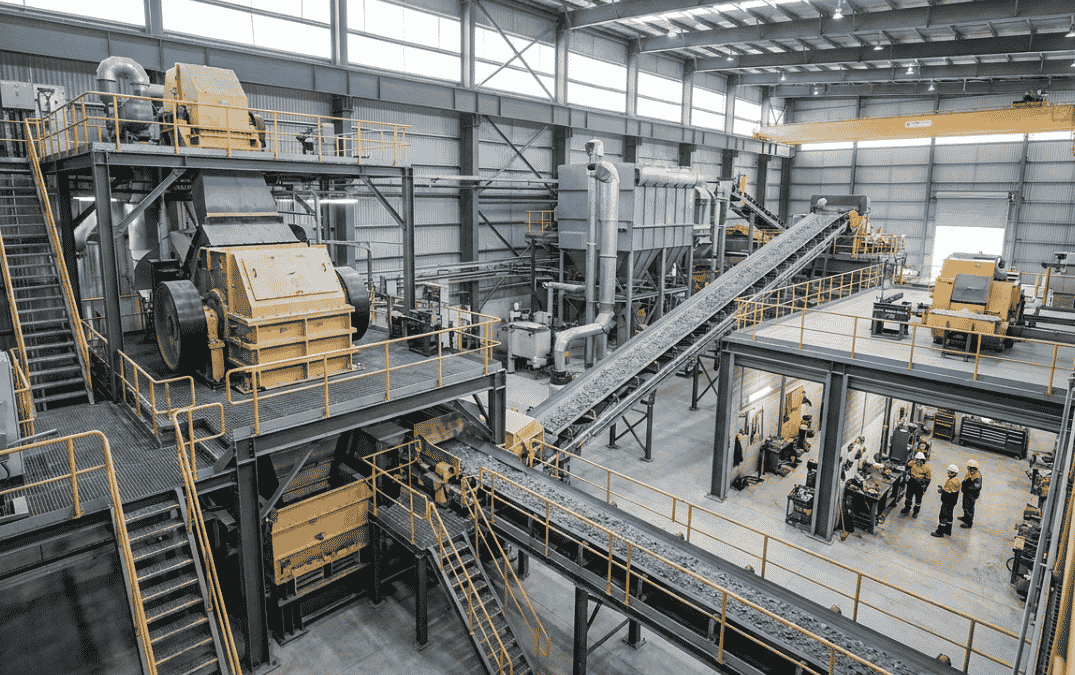
One of the strongest themes in modern process engineering is plant accessibility. Heavy mineral processing equipment cannot simply be squeezed into the smallest possible footprint to save on structural steel. Maintenance teams require dedicated, safe working space around equipment to perform daily inspections, change out wear components, and remove large mechanical assemblies without dismantling half the plant.
Consider a large cyclone feed pump positioned directly beneath low-hanging structural steelwork. It may have been easy to position with a crane before the roof was installed, but what happens three years later when a 5-ton motor or the entire pump casing needs to be replaced? Poor access can turn a straightforward four-hour repair into a 24-hour shutdown.
An intelligently designed, easy-to-maintain layout must incorporate:
- Adequate maintenance clearances around major rotating equipment.
- Designated access routes for forklifts, mobile cranes, and rigging equipment.
- Clear vertical and horizontal removal paths for motors, gearboxes, and exciters.
- Suitable lifting beams, monorails, or overhead crane coverage built into the primary structure.
The goal is not to create empty space, but rather to engineer usable maintenance space exactly where it will be needed. This directly correlates with why poor plant layout increases maintenance costs: when equipment placement is compromised during the design stage, labour requirements surge and long-term plant availability plummets.
Standardised Equipment Reduces the Maintenance Burden
A beneficiation plant containing dozens of different pump manufacturers, varying motor frame sizes, mismatched bearing housings, and unique gearbox configurations becomes a logistical nightmare to support. Every unnecessary variation introduces a new spare part to hold in inventory, a new seal kit to manage, and a new maintenance procedure for technicians to learn.
Where technically feasible, standardising equipment families across the plant can dramatically streamline maintenance operations. For instance, standardising motor sizes or pump models across similar duties allows the maintenance department to hold fewer critical spares while still providing comprehensive coverage for multiple plant areas. It also reduces repair times, as technicians build deep familiarity with a core set of equipment.
Wear Should Be Managed, Not Treated as a Surprise
Beneficiation plants process highly abrasive materials. Wear is not an abnormal event; it is a fundamental part of the operating environment. Chutes, transfer points, slurry pipelines, and tanks will all experience erosion depending on the ore’s mineralogy, particle size, and process velocity.
CSS Engineering improves maintainability by identifying these high-wear zones during the design phase and engineering solutions for controlled wear. Instead of allowing an expensive structural frame or primary mechanical component to become the wear surface, we integrate sacrificial components designed specifically to take the damage.
Quick-Change Components Reduce Shutdown Times
Wear components must be designed for rapid removal. A chute liner might be “replaceable” in theory, but if maintenance crews have to cut away handrails and dismantle adjacent pipework to reach it, the design has failed. Better maintainability includes bolt-in liners, split housings, slide-out modular assemblies, and flanged pipe spool pieces. When a component that typically takes eight hours to replace is engineered to take only two hours, the cumulative production savings over the life of the mine are massive.
Correct Comminution & Process Simplicity
Unnecessary process complexity introduces a heavier maintenance burden. Every additional pump, tank, conveyor belt, or automated valve creates another potential point of failure. A well-engineered flowsheet achieves the required metallurgical recovery without introducing redundant mechanical complexity.
Furthermore, the performance of the crushing and grinding circuits has a cascading effect on downstream maintenance. Poorly controlled feed conditions—such as excessive fines, irregular rock sizing, or overloading—increase mechanical stress on mill liners, screens, hydrocyclones, and pumps. Correct equipment selection during the comminution stage protects downstream assets, proving that good process engineering is inherently good maintenance engineering.
Condition Monitoring & 3D Scanning for Brownfield Upgrades
Modern operations are rapidly shifting from reactive, run-to-failure models toward predictive maintenance. Instead of waiting for catastrophic failure, conditions are monitored. CSS Engineering specialises in vibration analysis and dynamic balancing, helping plants detect mechanical looseness, bearing deterioration, and misalignment in rotating equipment long before it causes a major breakdown.
However, improving maintainability isn’t just for new, greenfield projects. Maintaining and upgrading older, existing beneficiation plants presents a unique challenge, as they often contain decades of undocumented modifications. A new pump skid or pipe route may look viable on old 2D drawings, but clash with existing steelwork during installation.
This is precisely how 3D scanning improves mining plant design accuracy. By capturing a highly accurate digital twin of the existing site, CSS Engineering can evaluate structural integrity, map out pipe routes, and confirm equipment removal paths before a single piece of steel is fabricated. This eliminates installation clashes and ensures that new upgrades genuinely improve, rather than hinder, maintenance access.
Safe Access: The Backbone of Routine Maintenance
Maintenance efficiency and workplace safety are inextricably linked. If technicians have to balance on narrow ledges or reach through moving parts to grease a bearing, routine servicing simply won’t happen as often as it should. Designing safer access around crushers, screens and conveyors—including engineered walkways, wide platforms, accessible isolation points, and compliant guarding—ensures that both inspections and major shutdown tasks can be executed safely and efficiently.
This safety aspect relies heavily on expert structural and fabrication engineering. The structural design dictates whether a plant can safely support the dynamic loads of vibrating screens while simultaneously providing vibration-free maintenance platforms for the crew.
How CSS Engineering Supports Maintainable Beneficiation Plants
CSS Engineering partners with mining and industrial clients to deliver engineering services that prioritise both metallurgical performance and long-term maintainability. Our capabilities ensure that maintenance isn’t an afterthought, but a core design criteria:
- Mining Process Plant Design: Developing layouts centered around equipment duty, realistic access, and future expansion.
- 3D Scanning & Engineering Design: Capturing precise site conditions to execute flawless brownfield upgrades and modifications without site clashes.
- Structural & Fabrication Engineering: Designing and fabricating heavy-duty platforms, equipment supports, and access structures that withstand mine conditions.
- Rotating Equipment Support: Providing vibration analysis, dynamic balancing, and condition monitoring to predict and prevent catastrophic mechanical failures.
Ultimately, a beneficiation plant is easier to maintain when the entire facility has been developed around how equipment will be accessed, isolated, removed, repaired, and safely returned to service. By partnering with CSS Engineering, mining operations ensure their plants are designed not just for high tonnage, but for high availability.
FAQs: Beneficiation Plant Maintenance
What makes a beneficiation plant easy to maintain?
A plant is highly maintainable when it features accessible equipment layouts, standardised mechanical components, easily replaceable wear parts, and integrated condition monitoring. Crucially, these features must be engineered into the plant’s structural and mechanical design from the beginning, rather than retrofitted after construction.
Why is plant layout so important for plant maintenance?
Layout dictates whether maintenance personnel and mobile lifting equipment (like cranes and forklifts) can safely reach heavy machinery such as crushers, screens, and pumps. Proper clearances, designated drop-down zones, and clear removal routes drastically reduce the time and labour required during maintenance shutdowns.
How can mining plants reduce unplanned downtime?
Unplanned downtime can be significantly reduced by transitioning to predictive maintenance techniques, such as vibration analysis and dynamic balancing. Additionally, installing sacrificial wear liners and engineering equipment for rapid component swap-outs ensures that when wear does occur, the fix is fast and planned.
How does equipment standardisation help maintenance teams?
Standardising equipment—such as using a consistent brand and size of motors, bearings, and slurry pumps where possible—reduces the volume of critical spare parts a mine must keep in inventory. It also accelerates repair times because technicians develop a deep, specialised familiarity with maintaining those specific models.
Can an existing plant be redesigned for better maintenance access?
Yes. CSS Engineering frequently upgrades existing (brownfield) operations using 3D scanning technology. This allows engineers to identify structural bottlenecks, spatial limitations, and clash points with millimeter accuracy. From there, new platforms, overhead lifting beams, and re-routed piping can be fabricated and installed to vastly improve access.
