
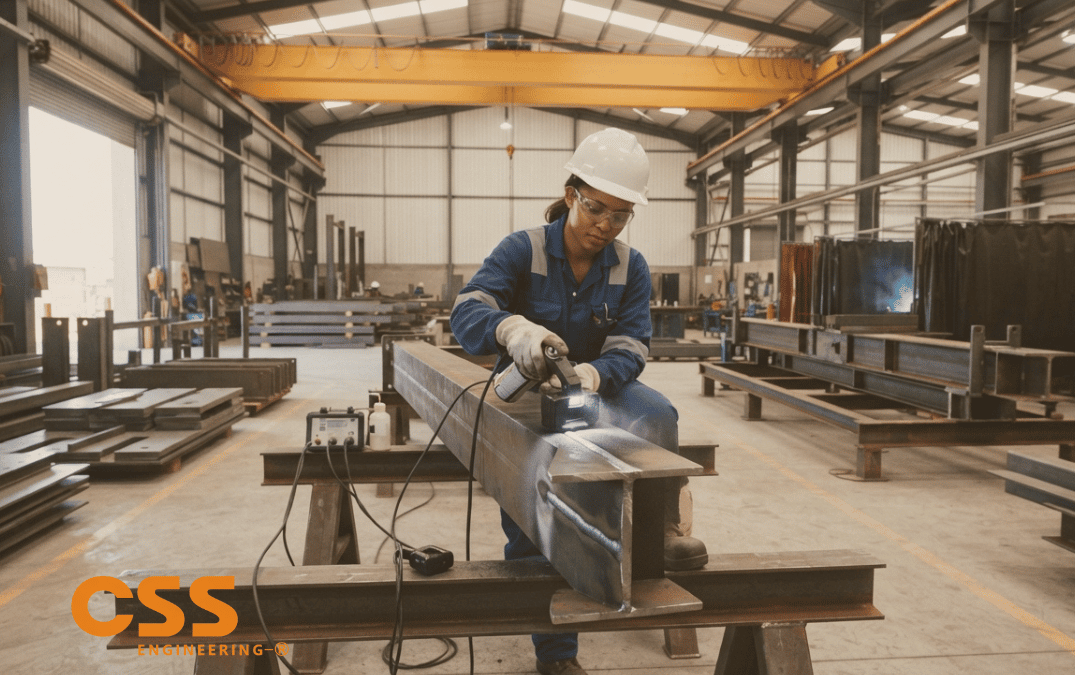
Why Structural Fabrication Quality Matters in Plant Design
By Ninya Claassen
Structural fabrication quality matters in plant design because the steelwork is what physically carries the plant. Crushers, screens, conveyors, piping and access platforms can only operate safely under heavy, vibrating loads if the frames, columns and connections are built exactly as engineered. Quality fabrication delivers five things: structural integrity under load, dimensional accuracy for fast erection, safety, long-term durability, and compliance with recognised codes. It depends on accurate cutting and fit-up, qualified welding, inspection and testing, correct surface protection and complete documentation.
A structural design calculation assumes three things: the steel is the specified grade, the welds are sound, and every member sits exactly where the drawing places it. Fabrication is where those assumptions either become true or quietly don’t. CSS Engineering designs, fabricates and erects structural steelwork for mining, mineral-processing and heavy industrial plants from its Meyerton workshop. Quality is controlled across the whole chain, from engineering design to site installation, instead of being inspected only at the end.
Key Reasons Fabrication Quality Matters in Plant Design
1. Structural Integrity and Load-Bearing
Plant steelwork carries far more than dead weight. Crushers impose impact loads, vibrating screens apply millions of load cycles, conveyor drives create tension and torque, and pipe racks carry pressurised lines. The design defines member sizes, connections, bracing and load paths, typically to SANS 10162-1 on South African projects. Fabrication then has to reproduce those details exactly: the correct steel grade, full-penetration welds where specified, and stiffeners and bracing in place.
A frame with an undersized weld or a missing stiffener may stand perfectly well on the day it’s erected. It can still crack, buckle or resonate once the plant runs. Around vibrating equipment, fatigue cracking at welded details is one of the most common structural failures. The weld profile and weld-toe quality largely decide how long a connection survives, which is why vibration and fabrication quality have to be considered together.
2. Dimensional Accuracy and Erection Efficiency
On site, millimetres matter. Bolt groups have to align, baseplates have to land on holding-down bolts, and equipment supports have to sit level so machinery can be aligned. SANS 2001-CS1 sets the fabrication and erection tolerances that structural steelwork is checked against. When a member falls outside them, the problem surfaces during erection, with crews and cranes already mobilised. It then gets fixed by cutting, re-drilling and field welding, often inside a tight shutdown window.
CSS Engineering’s workshop is set up to keep dimensions right before steel leaves the yard. It has plasma cutting machines with 13 m × 4 m and 4 m × 2 m beds, plate rolling, 200-ton and 300-ton bending, and in-house assembly, so components can be fitted together and checked in the workshop instead of for the first time on site. Accuracy starts upstream with reliable site data and clear drawings. We’ve covered that side in why accurate plant design data matters before fabrication and how fabrication drawings help prevent site installation delays.
3. Safety and Hazard Prevention
Poor welds, weak joints and sub-standard materials don’t stay a quality issue for long. A failed chute support, platform or pipe-rack connection can injure people, release hazardous process material or force an unplanned shutdown. Some elements carry personnel or suspended loads: walkways, stairs, handrails, lifting lugs and monorail beams. These need particular care, because they’re used every day by operators and maintenance crews.
The safe approach is to find defects before the structure enters service. That means inspection hold points during fabrication, qualified welders working to approved procedures, and non-destructive testing where the specification calls for it. For more on designing safe working areas around heavy equipment, see designing safer access around crushers, screens and conveyors.
4. Long-Term Durability and Maintenance
Mining and mineral-processing steelwork faces moisture, slurry, chemical exposure, abrasion, thermal cycling and constant vibration. How long it lasts is decided largely in the workshop. Good detailing avoids water traps, includes drain holes and seals crevices that would otherwise corrode from the inside. Surface preparation, typically abrasive blasting to Sa 2½ under ISO 8501-1, gives the coating something to bond to. The coating system should then match the site’s corrosivity category under ISO 12944, or be replaced by hot-dip galvanizing to SANS 121 (ISO 1461) where that suits the application.
Most premature coating failures start at poor preparation, sharp edges or weld spatter left on the steel, not with the paint itself. CSS Engineering includes surface preparation and protective coatings as part of its fabrication service, so protection is applied by the same team that built the steel. Durable steel also has to be maintainable, which we cover in what makes a beneficiation plant easier to maintain.
5. Regulatory and Standard Compliance
International summaries often cite ISO, ASTM and ASME. South African plant projects typically draw on these standards:
- SANS 10162-1 for structural steel design
- SANS 2001-CS1 for fabrication and erection, including tolerances
- ISO 3834, AWS D1.1 or ASME Section IX for welding quality and qualification, depending on the client specification
- ISO 9606-1 and ISO 15614-1 for welder and welding-procedure qualification
Compliance is demonstrated with documents, not claims. Typical evidence includes mill certificates traceable to the members they cover, approved welding procedure specifications, welder qualification records, dimensional and NDT reports, and coating thickness records, all handed over in a quality data book. CSS Engineering sets up welding procedures to each client’s specification in line with ASME IX, AWS D1.1 and ISO 3834.
What Quality Control Looks Like in Structural Fabrication
Quality isn’t a single final inspection. It’s a series of checks at the points where errors are cheapest to catch:
| Fabrication stage | What is checked | Why it matters |
|---|---|---|
| Material receipt | Steel grade, mill certificates, heat-number traceability | Confirms the structure is made from the material the design assumed |
| Cutting and preparation | Dimensions, hole positions, bevel and edge preparation | Errors here carry into every connection downstream |
| Fit-up | Alignment, root gaps and squareness before welding | Poor fit-up produces weak or distorted welds |
| Welding | Approved procedures, qualified welders, visual inspection and NDT | Weld defects are the most common route to structural failure |
| Dimensional check and trial assembly | Overall dimensions and connections against drawing tolerances | Prevents fit-up problems and rework during erection |
| Surface preparation and coating | Blast grade, surface profile, dry film thickness | Decides how long the steel resists corrosion |
| Documentation | Quality data book compiled and handed over | Proves compliance and supports future maintenance |
Where welds need testing beyond visual inspection, these are the common non-destructive testing (NDT) methods:
- Magnetic particle testing (MT): finds surface and near-surface cracks in carbon steel
- Dye penetrant testing (PT): finds surface-breaking defects, including on non-magnetic materials
- Ultrasonic testing (UT): finds internal defects in full-penetration and critical welds
- Radiographic testing (RT): gives a permanent image of internal weld quality
How CSS Engineering Builds Quality Into Plant Steelwork
When design, fabrication and erection sit with three different companies, a dimensional or connection problem tends to get passed between them while the site waits. CSS Engineering keeps the chain under one roof:
- Engineering design: 3D modelling, structural analysis and fabrication drawings, signed off by CSS’s own engineers. See engineering design services.
- Fabrication: plasma cutting, rolling, bending, drilling, welding and in-house assembly in the Meyerton workshop, with welding procedures set up to client specification.
- Protection: surface preparation and coating applied before dispatch.
- Erection and support: CSS’s own mobile cranes (15 to 35 ton) for installation, backed by site maintenance and repair teams.
The engineer who sized a connection is available to the workshop that builds it. And the team that fabricates the steel is the team that has to make it fit on site. Accountability isn’t split, so quality problems are much harder to pass along.
Questions to Ask Before Choosing a Structural Fabricator
- Which codes and welding standards do you work to? Expect specific answers, such as SANS 2001-CS1, ISO 3834, AWS D1.1 or ASME IX, not “industry standards”.
- Are welding procedures and welders qualified for this job? Ask to see the procedure specifications and welder qualification records.
- What inspection and NDT is included? Hold points and test extent should be agreed before fabrication starts, not after.
- Do you check fit before dispatch? Trial assembly in the workshop is far cheaper than discovering a misfit during a shutdown.
- Who owns the problem if it doesn’t fit? A fabricator that also designs and erects can’t pass a fit-up problem on to someone else.
- What documentation will we receive? A complete quality data book should be standard.
For plant projects where steelwork has to carry heavy, dynamic loads, fit an existing plant first time and last in harsh conditions, speak to CSS Engineering about the structural design, fabrication and installation as one package.
Frequently Asked Questions
What is structural fabrication quality?
It is how closely fabricated steelwork matches the engineering design and specification, covering material grade, dimensions, weld quality, surface protection and documentation. In a processing plant, it determines whether structures carry their loads, fit on site and last in service.
How does poor fabrication quality affect a processing plant?
It can cause misaligned connections and site rework during erection, fatigue cracking around vibrating equipment, premature corrosion, unsafe access structures and, in serious cases, structural failure and unplanned shutdowns.
Which standards apply to structural steel fabrication in South Africa?
Projects commonly use SANS 10162-1 for design and SANS 2001-CS1 for fabrication and erection tolerances. Welding quality is typically specified to ISO 3834, AWS D1.1 or ASME Section IX, depending on the client.
What NDT is used on structural steel welds?
Visual inspection is applied to all welds. Magnetic particle and dye penetrant testing find surface defects, while ultrasonic and radiographic testing check internal quality on critical or full-penetration welds, as the specification requires.
Why do fabrication tolerances matter during erection?
Plant structures connect to foundations, equipment and existing steelwork. Members outside tolerance cause bolt holes, baseplates and supports to misalign, which leads to cutting, drilling and welding on site and delays installation.
Does CSS Engineering design and fabricate structural steelwork?
Yes. CSS Engineering provides engineering design, structural steel fabrication, surface preparation and coating, and installation for mining, mineral-processing and heavy industrial plants from its Meyerton facility.
